TARGET SWITCHING 3DTRAINER
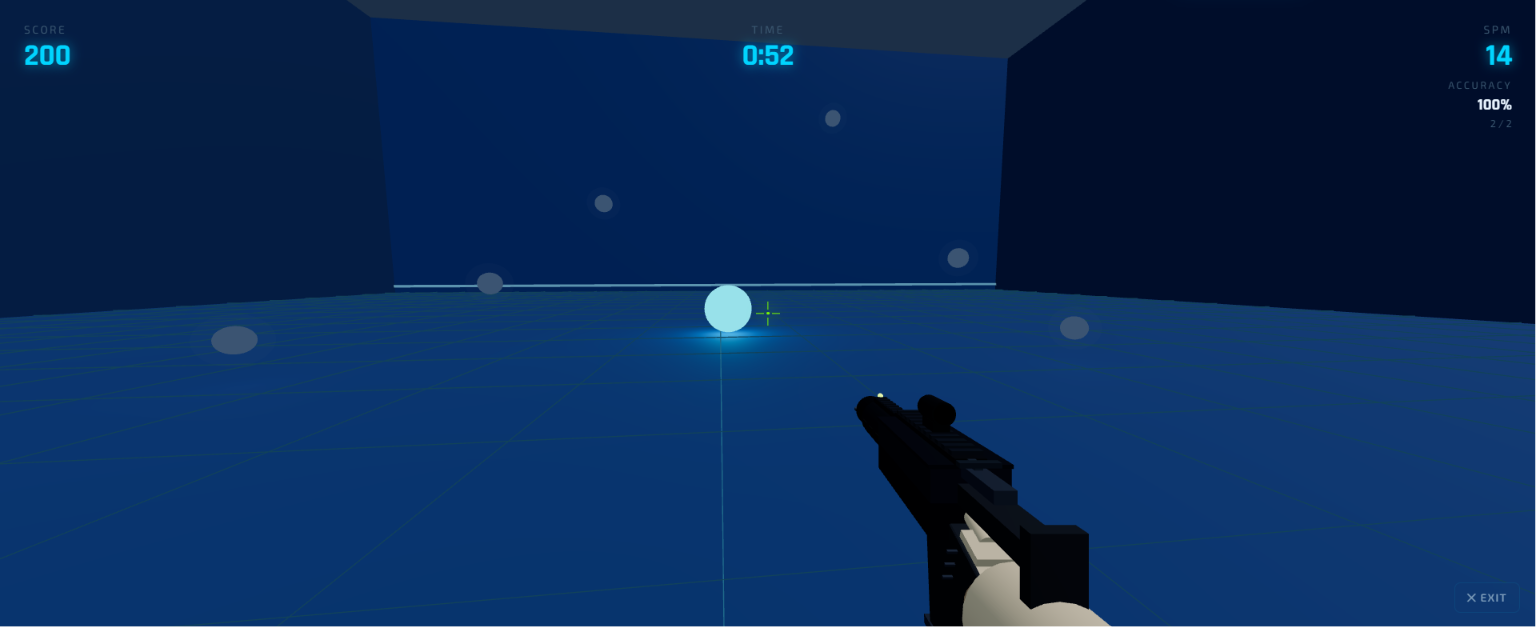
A 3D aim trainer focused on the transition between targets. Several fixed targets sit in a pointer-locked first-person arena — snap to the right one, confirm it, and fire. Sixty-second sessions, free in your browser.
Train Clean Transitions in a First-Person 3D Aim Trainer
Most aim drills test how you land on a single target. This one tests what happens between targets. Several fixed targets share the same first-person arena, and the work is the movement that carries your crosshair from the target you just shot to the next one you need — done quickly, but without overshooting and without firing on the wrong shape.
Because the targets do not move, every miss is purely a transition error: you rotated too far, too little, or pulled the trigger before the crosshair settled. That makes this 3d aim trainer a tight feedback loop for target switching, and a 60-second session leaves no room to coast — each switch counts.
How target switching works in this trainer
You are locked into a first-person view with several fixed targets in front of you. One target is active; you snap your crosshair onto it and fire, and a different fixed target becomes active. The whole drill is a chain of these jumps — your aim never rests on one spot for long.
The catch is that you have to land on the correct active target. Firing on a target that is not the active one is treated as a mistake: a wrong-target click costs score and breaks your streak. So the skill being trained is not just moving fast, but reading which target you actually want before you commit the shot.
Transition aim technique
A clean transition is mostly about ending the camera movement in the right place, not starting it fast. Push the crosshair toward the next target with one deliberate motion and aim to arrive just on the target rather than blowing past it and dragging back — that correction back-and-forth is wasted time and a common source of wrong-target hits.
Let the crosshair settle before you fire. In a fixed-target drill there is no reason to shoot mid-rotation; the target is not going anywhere. Arriving, confirming the target is the active one, and then clicking will beat a faster but sloppier swing almost every time.
Building a switching rhythm
Frantic, machine-gun snapping feels productive but usually produces overshoots and wrong-target clicks. A steadier, repeatable cadence — arrive, verify, fire, move on — lands more shots and is far easier to reproduce under pressure in a real match.
- Find the pace at which your accuracy holds, then keep every switch at that same tempo.
- Treat each switch as its own small motion that finishes before the next one starts — do not let two transitions blur together.
- Let your accuracy set the speed: if you start clicking wrong targets, you are going faster than your reads allow, so ease the cadence back.
- Aim for a rhythm you could keep up for the full 60 seconds, not a burst you can only sustain for ten.
Common target-switching mistakes
- Over-rotating past the next target: swinging with too much speed so the crosshair sails past and you have to drag it back, doubling the time the transition takes.
- Firing on the wrong target: clicking the nearest shape instead of the active one. A wrong-target click costs score and ends your streak, so confirm the target before you commit.
- No consistent rhythm: alternating between rushed snaps and hesitant ones. An erratic cadence makes every switch a fresh guess instead of a repeatable motion.
- Shooting before the crosshair settles: pulling the trigger while the camera is still moving scatters the shot — let it arrive first, then fire.