FLICK SHOT 3DTRAINER
Flick a pointer-locked first-person camera onto targets that spawn around you in a 3D arena — the same depth and turning feel as a live FPS match, not a flat plane. Free, in your browser, no download.
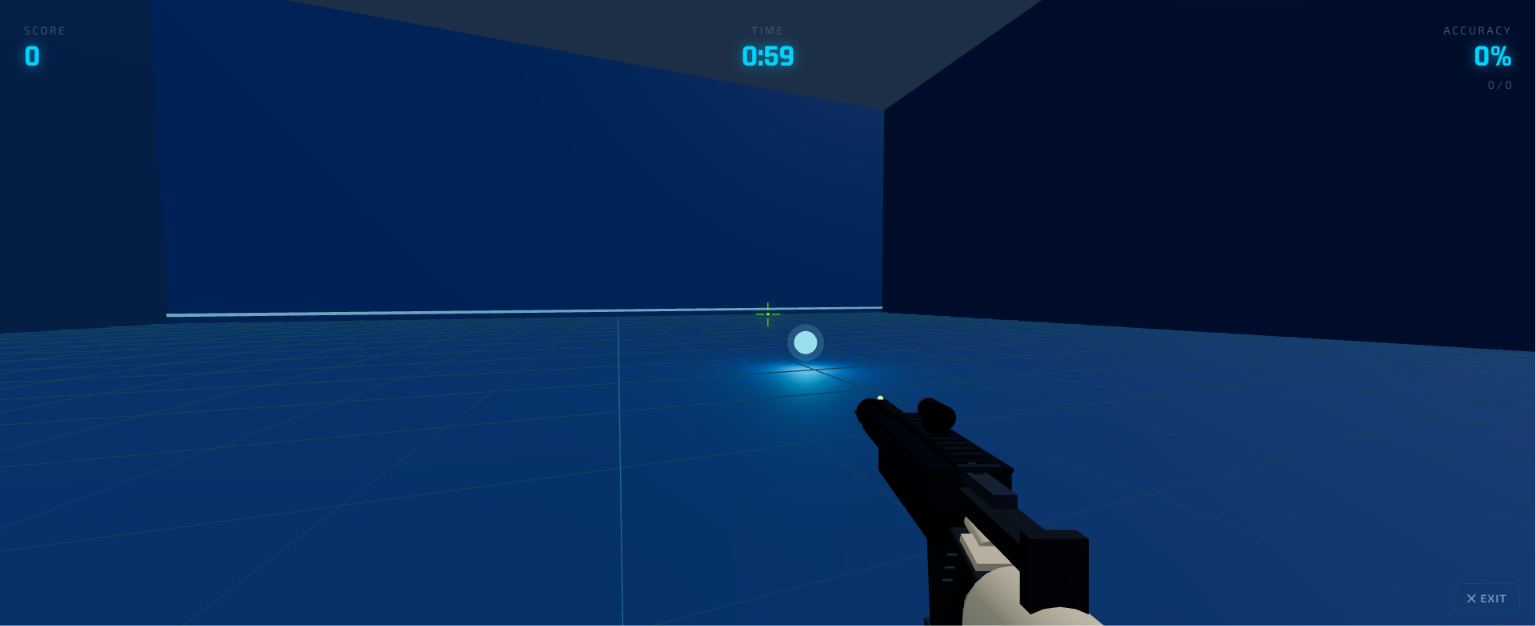
First-Person Flick Training in a Real 3D Arena
This 3D aim trainer drops you inside a first-person arena where your mouse turns the camera exactly like a competitive shooter does. Click to lock the pointer, a single target lights up somewhere in the space around you, and you swing the whole view onto it and fire — then the next one spawns and you do it again for 60 seconds.
The point of training flicks in 3D is that the movement transfers. You are practising the same camera turn, the same sense of distance, and the same settle-then-shoot timing you rely on in your actual game — not just tapping flat circles on a canvas.
Why 3D flicking is closer to your real game
A 2D trainer asks you to move a pointer across a flat surface. A 3D flick trainer asks you to rotate a first-person camera, which is the motion your hand actually performs in Valorant, CS2, or Apex. Because the pointer is locked, raw mouse movement maps straight onto camera yaw and pitch — there is no desktop cursor in the way.
Targets here are placed in 3D space, so they can sit anywhere across a full 360-degree arc and at different apparent distances. A near target needs a small turn; a far one off to your side needs a wide swing. That depth and angular spread is the part flat trainers cannot reproduce, and it is what builds the turning muscle memory you carry back into a match.
How scoring and the S/A/B/C/D rating work
Every hit pays a base amount plus a time bonus that grows the faster you snap onto the target after it appears. On top of that, consecutive hits build a streak multiplier: reach a 5-hit streak and your points are multiplied by 1.5x, and a 10-hit streak pushes that to 2x. A miss resets the streak, so clean runs are worth far more than scrappy ones.
At the end of a 60-second session you are graded on both accuracy and total score together. S needs 90%+ accuracy and 12,000+ points; A needs 75% and 8,000; B needs 60% and 5,000; C needs 40% accuracy; below that is D. Because score and accuracy both count, you cannot grade up by spamming clicks — you have to flick fast and land them.
Setting your 3D sensitivity so it carries over
Think about sensitivity in terms that travel between games rather than a single slider. cm/360 — the distance your mouse travels to turn a full circle — and eDPI (DPI multiplied by in-game sensitivity) describe the same turning speed in any title, so you can match this trainer to your main game instead of guessing. Many players sit somewhere around the 200–400 eDPI range as a general starting point.
The single most useful habit is consistency: pick one turning speed and keep it identical here and in your game. A flick is a learned distance, and if that distance keeps changing your hand never gets to memorise it. Train at the same cm/360 you play at and the reps you build in this 3D arena show up directly in ranked.
Common 3D flick mistakes
- Over-flicking past the target: in 3D a wide turn carries more momentum than a flat swipe, so it is easy to whip straight past. Aim to stop just short and finish with a small correction rather than dragging back.
- Firing before the camera settles: clicking while the view is still rotating throws the shot wide. Train the rhythm of flick, settle, then fire — the time bonus rewards speed, but only on hits.
- Running a different sensitivity here than in your game: if your cm/360 in the trainer does not match your main title, the muscle memory does not transfer and every flick is a fresh guess.
- Only ever facing one direction: targets spawn all around you, so practise turning to wide angles and downward or upward pitches instead of pre-aiming a comfortable zone.