GRID SHOTTRAINER
Several targets sit on screen at once, and every hit spawns a fresh one — so the real skill is the fast, clean transition from one target to the next. Build efficient movement and let your streak climb without a single miss.
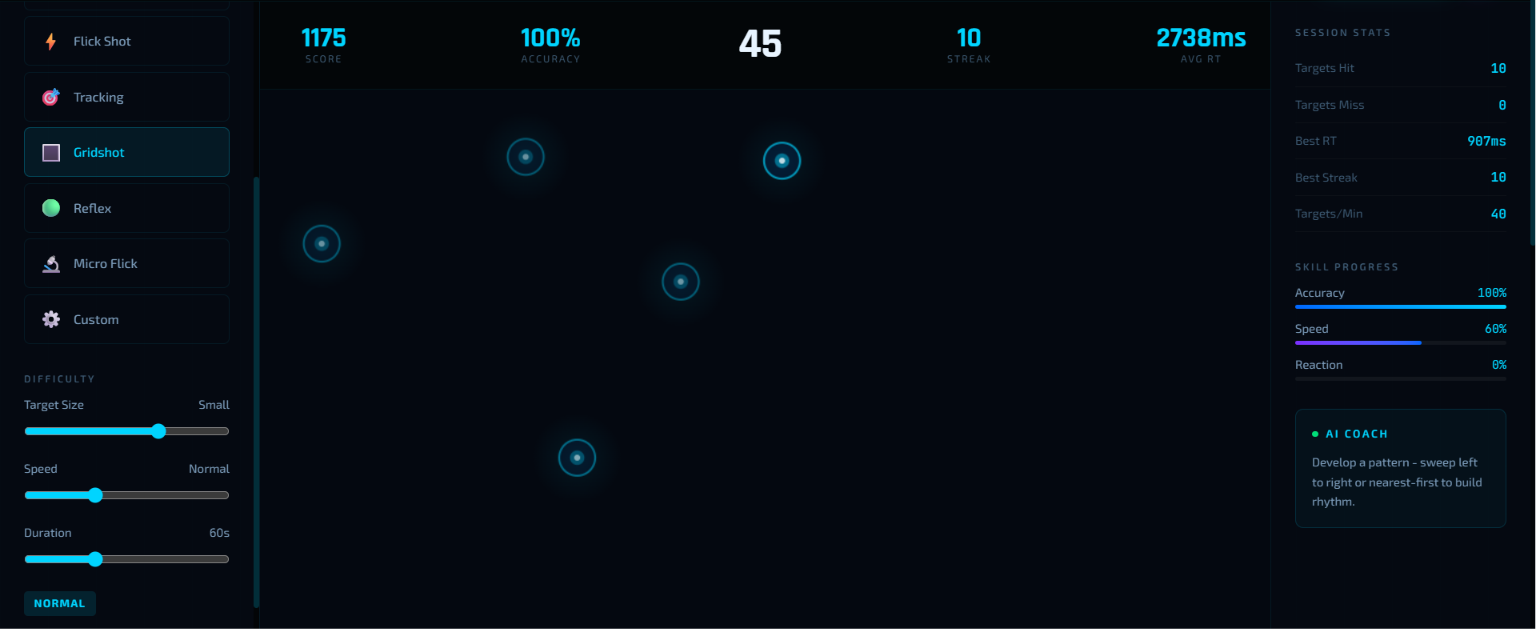
Grid Shot: Train Fast, Clean Target Switching
Grid shot is a multi-target click drill: instead of one dot at a time, several targets sit on the grid at once, and the moment you destroy one, another appears somewhere else. That small rule changes everything — the bottleneck is no longer a single snap, it's how efficiently you move between targets without overshooting or hesitating.
Because the board is always full, grid shot rewards a steady plan over panic. A relaxed run that clears targets in a sensible order will out-score a frantic one almost every time, which is exactly why it has become a staple warm-up for FPS players.
How grid shot works
Multiple targets are visible simultaneously, and each kill immediately spawns a replacement, so the grid never empties. The thing you are really practising is the transition — the short, controlled movement that carries your crosshair from the target you just hit to the next one you choose.
Scoring leans on a streak multiplier: an unbroken run of clean hits keeps building value, and a single miss resets it. That structure quietly pushes you toward control, because two careful hits in a row are worth more than three rushed clicks where one of them whiffs.
Pattern vs. random clicking
When the grid is full, your eyes want to jump to whatever flashes brightest, and that turns into random clicking with long, wasteful crosshair travel back and forth across the screen. A simple system fixes most of it: clear the nearest target to where your crosshair already is, then the next nearest, sweeping through the cluster instead of bouncing across it.
Working in a loose pattern — left-to-right, top-to-bottom, or just always taking the closest target — shortens every transition and lets you settle into a rhythm. Once the spacing between clicks feels even, your accuracy stabilises and your speed rises on its own, without you trying to force it.
Speed vs. accuracy
Grid shot is built around one trade-off: go faster and you start clipping the edges of targets or missing outright; slow down and your streak survives but your score-per-second drops. The useful move is to find the pace where your accuracy still holds, treat that as your baseline, and then nudge the speed up only after the cleaner pace feels comfortable.
Training accuracy-first builds better habits because every clean transition is a rep your hands can repeat. Chasing raw speed before control just teaches your arm to spray, and that spray follows you into the game — so let speed be the reward for accuracy, not the thing you reach for first.
Common grid shot mistakes
- Spray-clicking at random: stabbing at whichever target catches your eye creates huge, wasted crosshair travel. Take the nearest target and work outward instead.
- Over-flicking between close targets: two adjacent targets only need a small nudge, but it's easy to flick like they're across the screen and shoot straight past. Scale the movement to the actual gap.
- Tensing up: a clenched grip and stiff arm make small transitions jittery. Keep the hand relaxed so corrections stay smooth.
- Chasing speed over accuracy: clicking faster than you can aim breaks your streak and tanks the multiplier. Hold a pace you can keep clean, then build from there.