FLICK SHOTTRAINER
Train the explosive snap-to-target flick that wins opening duels in Valorant, CS2, and Fortnite. Static targets, adjustable size, and streak scoring build the muscle memory for a clean first shot.
How to Train Flick Shots That Win Duels
A flick shot is a single, explosive mouse movement that snaps your crosshair from where it rests directly onto a target the instant that target appears. In tactical shooters like Valorant and CS2, the first shot usually decides the duel — so the speed and accuracy of that flick is often the difference between the kill and the respawn screen.
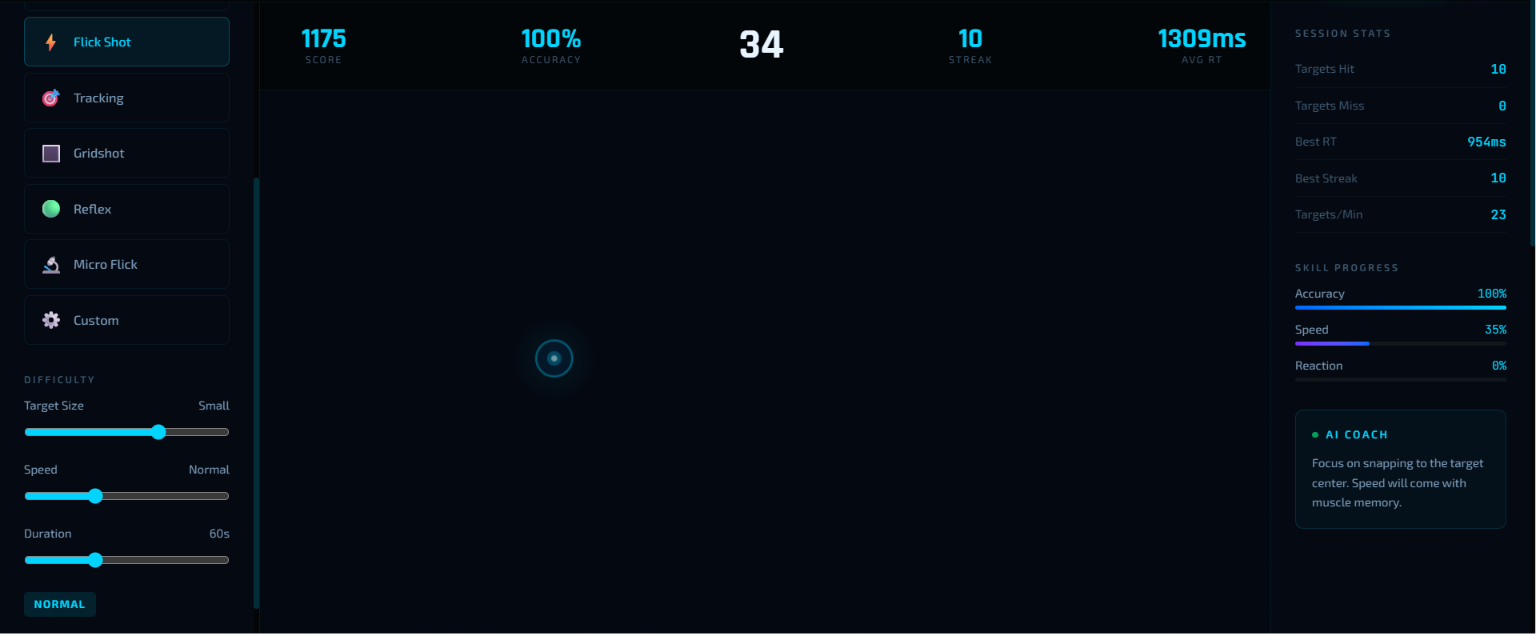
This flick shot trainer isolates that one skill: a single target appears at a random position, you flick to it and click, and a new one spawns. Because nothing is moving, every rep is pure first-shot accuracy — no tracking, no movement, just the snap.
How the flick trainer works
One target spawns at a time at an unpredictable position, so you can't pre-aim — you have to react and flick to it. You control two things: target size (from large warm-up targets down to tiny precision dots) and session length (from 30 seconds up to 3 minutes).
Scoring rewards consistency, not just speed. A streak of consecutive hits raises your score multiplier, so an unbroken run of clean flicks is worth far more than the same number of hits split up by misses. That pushes you to flick accurately rather than spray and pray.
Wrist aiming vs. arm aiming
Flick training quickly exposes how you actually aim. Arm aiming — moving from the elbow at a lower sensitivity — gives more repeatable big flicks and is the norm among tactical-shooter pros. Wrist aiming at a higher sensitivity is faster for small corrections but harder to repeat on wide flicks.
Most players settle in a low-to-mid sensitivity range, where the bulk of a flick comes from the arm and the wrist handles the final micro-correction. Whichever you pick, commit to it — the trainer can only build memory around a stable sensitivity.
A simple flick progression
- Warm up on large targets until your hits feel automatic.
- Drop the target size one step, and stay there until your accuracy recovers before shrinking again.
- Finish each session with a short burst of the smallest size you can hit consistently — that's where real precision is built.
- Run 5–10 minutes before ranked. The goal is a warm, repeatable flick, not a personal-best score.
Common flick mistakes
- Overshooting: flicking past the target and dragging back. Aim to land just short and let a tiny correction finish the shot.
- Changing sensitivity constantly: muscle memory can't form if your distance-to-movement ratio keeps shifting. Pick one and commit.
- Firing before the crosshair settles: clicking mid-flick scatters your shots. Train the flick-then-fire timing, not just the flick.
- Inconsistent crosshair placement: starting every flick from a random spot makes every flick a new problem. Keep your crosshair near likely engagement height.